
Smoke haze returned to Singapore at the start of September 2026. On 4 September the 24-hour PSI in the central region crossed into the Unhealthy band for the first time since October 2023. Most offices reacted the same way: close the windows and carry on with the day.
That helps, but only a little. An air-conditioned office is not sealed. Fine dust comes in through fresh air intakes, lift lobbies and every door that opens onto a street or a car park. It settles on carpets, fabric panels and flat surfaces, and foot traffic then stirs it back into the air. Protecting office indoor air quality during a haze period is a cleaning and maintenance job as much as a ventilation one.
What Haze Brings Into Your Building
The Pollutant Standards Index, or PSI, combines several pollutants. During regional smoke haze the main one is PM2.5. These particles are small enough to stay in the air for hours and to pass through ordinary coarse filters. NEA reports the 24-hour PSI in five bands: Good at 0 to 50, Moderate at 51 to 100, Unhealthy at 101 to 200, Very Unhealthy at 201 to 300, and Hazardous above 300.
Government agencies published coordinated measures to mitigate the impact of haze as conditions worsened, and the Ministry of Manpower advised employers to cut back on prolonged or strenuous outdoor work. Indoor workplaces get far less attention in public advisories. That is one reason so many facilities teams have no plan ready when the readings climb.
Start With the Air Filters
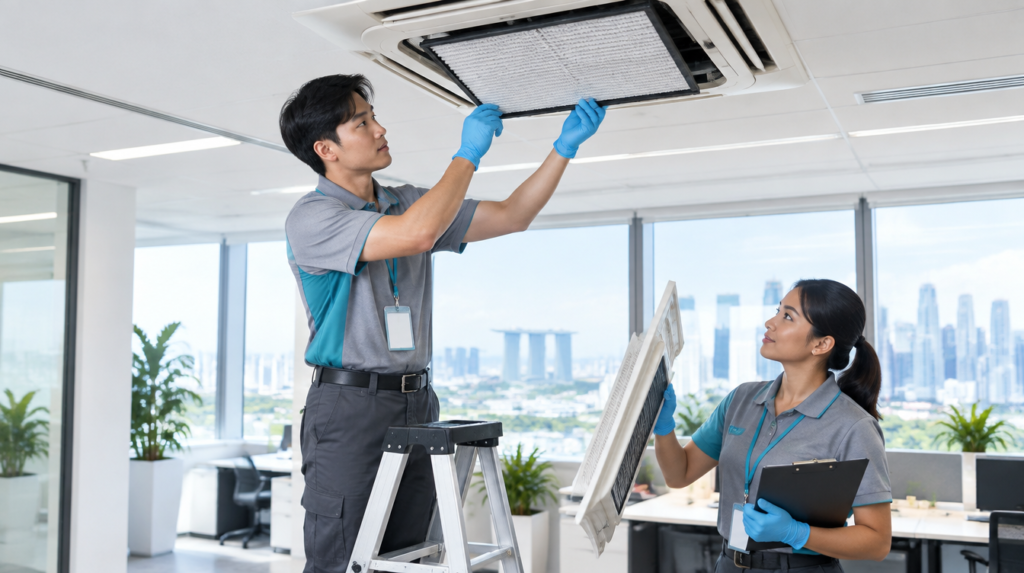
The biggest single improvement sits in the air handling system, not on the cleaning trolley. The Workplace Safety and Health (WSH) Council’s guidelines on the management of indoor air quality recommend two-stage filtration during haze. A coarse pre-filter catches the larger particles and a finer second filter catches what gets through.
Filter changes are where most buildings fall behind. A filter should be replaced once it reaches the pressure drop the system was designed for, and during a haze period it reaches that point much sooner than usual. If the replacement schedule stays the same all year, airflow drops and complaints rise at the same time.
Most tenants cannot arrange this themselves, because the air handling units serving a floor belong to the landlord. Ask building management in writing, and ask early. A written request usually gets a faster answer than a phone call made after staff have started complaining of headaches.
Stop Settled Dust From Being Stirred Up Again
Dust that has already entered the building does not simply disappear. It collects in carpets, soft furnishings and along ledges. Dry dusting and sweeping push much of it straight back into the air, so the cleaning method makes a real difference to what people breathe. A few changes help during a long haze period:
- Wipe desks, window sills, ledges and partition tops with a damp cloth, since a dry cloth lifts more dust than it removes
- Vacuum carpets and fabric workstation panels with HEPA-filtered machines, and vacuum busy areas more often
- Wipe air conditioning grilles and diffusers, because dust builds up there and is blown back into the room
- Clean lift lobbies, staircases and entrances more often, as these collect most of the dust brought in on shoes
- Add high-level surfaces such as cable trays and the tops of cupboards, which are easy to miss on a quick nightly round
- Deep clean fabric chairs in meeting rooms where people sit for long periods
Carpets hold far more dust than they appear to. Regular carpet cleaning has a direct effect on the air in the office. Letting soil build up through a hazy month cancels out much of the benefit of better filters.
Clean the Entrances More Often
Most of the dust that reaches your floor arrives on shoes and clothing. A proper matting system at the main entrance catches a good share of it, which means a coarse scraper mat outside the door and an absorbent mat inside. Mats only work while they still have capacity, so during a haze period they need vacuuming or swapping far more often than usual.
Indoor Sources Add to the Problem
Dust from outside is the obvious problem, but it is rarely the only one. SS 554:2026, the Singapore Standard code of practice for indoor air quality in air-conditioned buildings, sets acceptable limits for formaldehyde, volatile organic compounds, carbon dioxide and particulate matter. A floor that has recently been fitted out can have poor air quality for reasons that have nothing to do with the haze.
New furniture, fresh joinery and new carpet all release formaldehyde and other compounds for months after installation. Staff often blame the haze for the headaches and eye irritation that follow. If the timing of your fit-out points that way, formaldehyde removal services treat the source directly instead of relying on ventilation to dilute it.
When to Test the Air
If complaints continue after you have improved filtration and tightened the cleaning schedule, the next step is to measure. The WSH Council recommends regular indoor air quality audits alongside walk-through checks for mould, water leaks and faulty equipment. A short round of monitoring usually shows where the problem lies: the filters, the cleaning, or a source nobody had considered.
Planning for the Next Haze Period
Haze comes and goes, and no building manager can control it. What happens inside the building is within your control. Better filters, more frequent damp cleaning, closer attention to carpets and soft furnishings, and entrance mats that are properly maintained all make a noticeable difference over a difficult few weeks.
We are bizSAFE STAR certified, hold NEA Clean Mark Silver accreditation and are ISO 45001 certified, and our teams look after more than 600 client sites across Singapore. If the air on your floor has felt heavy this season, talk to us at Abba (Abba Maintenance). We would be glad to work out a schedule that suits your space, your traffic and the weeks when conditions are at their worst.


 on Google