
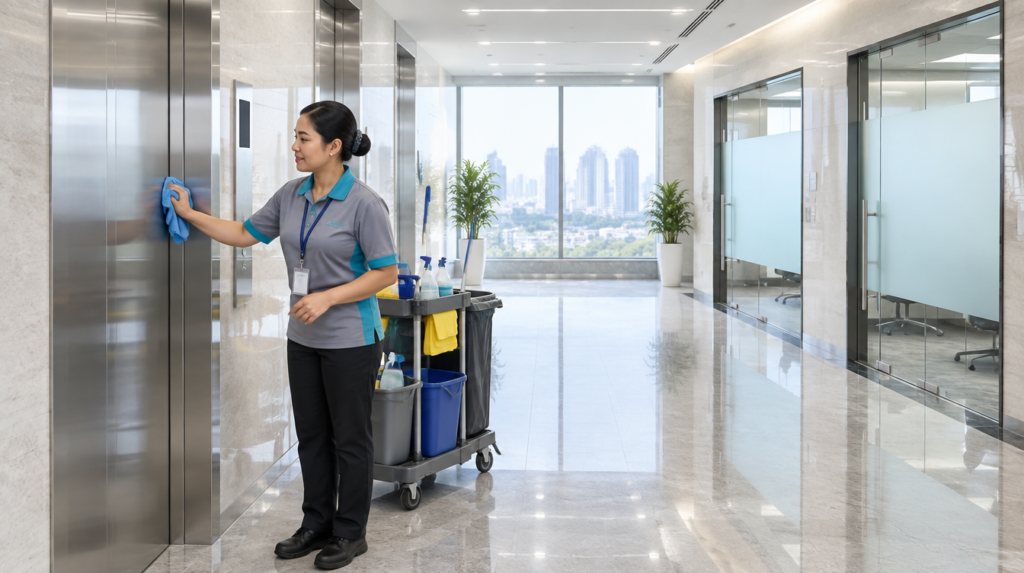
Cleaning a single-tenant office is easy to describe. One occupier, one boundary, one contract. Move into a multi-tenanted tower and that clarity disappears, usually on the morning a client is due.
The standard arrangement sounds simple enough. Building management cleans the common property and the tenant cleans its own premises. Between those two statements sits a set of surfaces nobody has clearly claimed. Office common area cleaning is where most disputes in shared buildings start, and the fix is a conversation that should have happened at fit-out.
Where the Line Usually Falls
Building management normally covers the ground floor lobby, lift cars and lift lobbies, common corridors, fire staircases, car parks and any washrooms serving the whole building. The tenant covers everything inside its own premises: carpets, workstations, meeting rooms, the pantry, internal glass and the waste all of it produces.
The difficulty is that a line in a tenancy agreement is a legal boundary, not a practical one. A tenant on a full floor treats the lift lobby as its reception area. The landlord’s contractor cleans it to a specification written for general circulation space. Both sides are being reasonable and the result still disappoints everyone.
What the Tenancy Agreement Covers
The service charge usually commits the landlord to cleaning the common property to a reasonable standard and says little more. Frequencies, scope and working hours sit in the building’s own cleaning specification rather than in the lease itself. Asking building management for a copy of that specification is the most useful thing a new tenant can do, and the request is almost never refused.
How Often Is Just as Important as Who
Scope tells you who cleans a surface. Frequency tells you how often. Both need answering. A building might mop common corridors daily and clean lift interiors weekly, which is fine for a quiet floor and clearly not enough for one taking visitors all day.
Tenants in premium space often want a higher standard in the areas their clients walk through than the building has paid for. Most landlords will allow it, though rarely at their own cost. The usual options are an extra service charge for higher frequency in named areas, or written permission for your own contractor to work in that space on an agreed schedule.
Either way, put it in writing. An informal arrangement where your cleaner quietly wipes the lift lobby each morning works for a while. Then the building changes contractors, or a new security policy restricts access outside your premises, or an incident raises the question of whose insurance responds. A short exchange of emails at the start prevents all three.
The Areas That Fall Between
The same handful of areas causes most of the friction in shared buildings:
- The lift lobby on a single-tenant floor, which the landlord treats as circulation space and the occupier treats as its front door
- The inside face of the entrance glazing, along with the tenant’s signage panel and door handles
- Shared pantries and washrooms on floors split between two occupiers, where neither party owns the consumables
- Fire staircases just outside a tenant’s door, which collect dust and packaging and belong to nobody in daily practice
- The outside face of the windows, which usually sits with a separate facade contractor on its own schedule
Leaving these unclear is expensive in a quiet way. Either the area is cleaned twice and paid for out of two budgets, or it is cleaned by nobody at all. In the second case the complaint lands with the office manager, who has no contractual way to fix it.
Glass Shows the Gap First
Glass is the surface visitors notice, and the one most often split down the middle. The outside face of a curtain wall normally sits in a building-wide facade contract, while internal partitions, entrance doors and meeting room glazing stay with the tenant. Glass cleaning covers the internal side of that split. Agreeing who handles which face avoids the familiar result of clean glass on one side and smears on the other.
Fire Staircases Are Not Storage
Fire staircases attract clutter in shared buildings precisely because nobody feels responsible for them. The Fire Code is clear on the point. SCDF requires that means of escape are kept unobstructed and available at all times, which rules out using a staircase landing for spare boxes, broken chairs or surplus furniture.
Cleaning contractors can add to the problem by parking trolleys and chemicals on a landing between floors. Agreeing a lockable store inside your premises, or a designated area provided by building management, settles it before a fire safety inspection does.
How to Set Up a Split That Holds
Start by getting the landlord’s cleaning specification in writing, including frequencies and the hours the building’s crew works. Map your own scope of work against it and mark every surface that appears in neither document.
Price those gaps into your own contract instead of leaving them to goodwill. A short written confirmation with building management, naming the areas your contractor will cover and the areas it will not, costs nothing and stops two crews circling the same lobby.
The same approach scales up. Office cleaning for large corporations across several floors or several buildings works best when every site follows one specification, with local variations recorded as exceptions. Review the split once a year, or at each lease renewal, so it keeps up with how the space is actually used.
Clarity Costs Less Than Confusion
Shared buildings work well when the boundaries are written down and both sides know where their responsibility ends. Most of the friction facilities teams run into comes from a scope gap that nobody documented at the start, not from poor standards on either side.
We are bizSAFE STAR certified, hold NEA Clean Mark Silver accreditation and are ISO 45001 certified. We work across more than 600 client sites in Singapore, many of them in multi-tenanted towers. If you would like help mapping your scope against your building’s, the team at Abba (Abba Maintenance) is always happy to sit down and work through it with you.



 on Google