
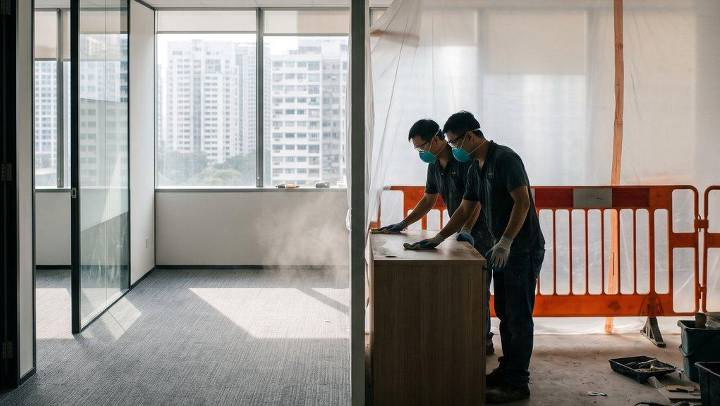
Renovating a whole office at once is a luxury most companies cannot afford. The usual compromise is a phased fit-out, with half the floor behind hoarding and the other half still trying to take client calls. The cleaning plan is normally the last thing anybody thinks about.
That ordering causes problems. Construction dust travels further than people expect. It settles in places a routine clean never reaches, and it keeps arriving for weeks after the contractor has packed up. Making your new office move-in ready on a fixed deadline demands the same discipline, but a phased fit-out adds a complication: people are working on the other side of the hoarding the whole time. A deliberate plan costs very little and prevents a long tail of complaints.
Dust Does Not Respect the Hoarding
Temporary partitions stop debris. They do very little about fine dust, which moves on air currents and through the gaps around door frames, floor junctions and ceiling voids. Drilling and cutting push it up into the ceiling plenum, where the return air picks it up and delivers it to rooms nobody has worked in.
Sealing helps more than screening. Taped joints at the floor and ceiling, a sealed temporary door, and tape over the return air grilles on the works side all cut the volume reaching the occupied area. Ask the contractor to confirm what has been sealed, not just what has been erected. A quick walk of the boundary at the end of the first working day usually shows where the gaps are.
Negative pressure on the works side is the stronger control where the programme allows it. Air is drawn out of the construction zone and filtered, so leakage runs towards the dust instead of away from it. Fit-out contractors here can usually arrange this, and it rarely gets requested. Ask for it at tender stage, where it costs very little, instead of halfway through the works.
New Materials Release More Than Dust
Fresh joinery, adhesives, paint, carpet and laminates give off volatile organic compounds, formaldehyde among them. The release is highest when materials are new and tapers over time. Staff sitting twenty metres from a new carpet installation often notice it before any instrument does. Complaints tend to cluster on Monday mornings, after a closed weekend with the air-conditioning off.
Ventilation is the first response. Increasing fresh air supply, and running the system for a period before occupants return, both help. Where the fit-out is large or the complaints persist, formaldehyde removal services treat the affected materials directly instead of waiting out the natural decline. Treatment works best once materials are installed and the dust has been removed, so it belongs at the end of the sequence.
Sequence the Cleaning Properly
Cleaning during a live renovation runs in four stages. Running them out of order wastes most of the work.
- Daily containment cleaning of the occupied side, covering the boundary, the lift lobby and the route the workers walk.
- A rough clear-down of the works zone as trades finish, so debris does not get walked through the building.
- A builder’s clean of the completed zone, removing adhesive residue, plaster film, paint spots and swarf.
- A detail clean after airborne dust has had time to settle, which usually means a return visit rather than one sweep on handover day.
Protect the Occupied Side Daily
Entrance matting at the boundary catches a surprising amount before it reaches carpet. Damp wiping beats dry dusting throughout, because a dry cloth relocates fine dust instead of removing it. Vacuums fitted with high-efficiency filtration keep hold of what they collect.
Pay attention to the horizontal surfaces people forget. Five of them account for most of the complaints that arrive after a fit-out.
- Monitor tops and the back edge of desks, where dust shows against dark plastic.
- Window sills and blind headboxes, which are rarely in the routine scope.
- Cable trays and floor boxes, where debris collects and stays.
- The upper edge of partitions and glazing frames, at eye level for anyone standing.
- Tops of filing cabinets and lockers, disturbed the moment somebody reaches up.
Frequency should rise while the works run. An office cleaned three times a week often needs daily attention during a fit-out, and the extra visits can stop when the programme ends. Agree that uplift in advance so it does not turn into a variation argument. Set an end date for the extra visits at the same time, tied to practical completion rather than a calendar month.
Agree the Boundary With the Contractor
Fit-out contracts usually include a clean, and that clean is usually a sweep. It is rarely the standard an occupied office needs, and the gap only becomes visible on handover day. Settle in writing which party covers the builder’s clean, the detail clean and the daily occupied-side work. Where your cleaning provider takes the builder’s clean, give them access before the handover inspection. Finding adhesive residue on a Monday morning with staff already seated is an expensive way to discover the scope was unclear.
Check the Work Before You Sign
Walk the completed zone with a torch held at a low angle. Raking light across a surface shows film and streaking that overhead lighting hides completely. Look at the grilles, the skirting line, the underside of desks and the inside of newly fitted cupboards. Take photographs of anything you want corrected, and send them the same day while the trades are still on site.
A new floor deserves its own inspection. A clean that leaves adhesive haze on vinyl, or grout film on tile, is far harder to correct once furniture is in position and the room is occupied.
Treat It as Part of the Project
Bringing your cleaning provider into the programme at the planning stage, alongside the contractor, is the single change that prevents most of this. It gives them time to price the uplift, book the return visits, and agree the boundary before the first panel of hoarding goes up.
Costs stay lower when the work is scheduled rather than rescued. A planned detail clean is a line item. The same clean ordered on handover morning is an emergency, priced accordingly and staffed by whoever happens to be free. Staff returning to a floor that still carries film will say so, and the second clean costs more than the first would have.
Abba works on phased fit-outs across Singapore and can sit in on the programme discussion with your contractor. Tell us the renovation dates and the areas involved, and we will put a plan together around them.

 on Google