
A facilities manager usually meets waste reporting through a landlord’s email. The building needs recycling figures, and it needs them by a date that has already nearly arrived. Nobody in the office has been counting.
The reporting obligation itself sits with specific categories of premises, and most tenanted offices are not among them. The practical demand still lands on tenants, because a building cannot produce a credible number without them. Knowing where the duty actually sits makes that conversation much shorter.
Who NEA Requires to Report
Under NEA’s mandatory waste reporting requirements, owners, occupiers or lessees of a workplace must submit a waste report when they receive a written notice from NEA. A workplace here means premises used for industrial, trade, commercial or manufacturing purposes.
The categories listed cover hotels with more than 200 rooms and shopping malls above 4,600 square metres of net lettable area. They also cover factories above 20,000 square metres of gross floor area, warehouses above 50,000 square metres, and convention and exhibition centres above 8,000 square metres. An ordinary office tenancy does not appear on that list.
What a reportable premises must submit goes well beyond a tonnage figure. The report covers quantities disposed of and recycled in the preceding year. It also covers details of the waste management system, plus a waste reduction plan and a progress update on measures already in place. Requirements are revised from time to time, so check the current NEA page before committing to anything in writing.
Why Your Office Still Gets Asked
Building owners cannot report what they cannot measure. A mall or a mixed-use development reports at building level, and tenant waste forms part of that total. The request often arrives with little notice, because the building is working to its own deadline. Five things tend to be asked for:
- Estimated volumes of general waste over the reporting year.
- Estimated volumes recycled, usually split by stream.
- The collection arrangement, including who removes what and how often.
- A description of the segregation practice in the tenancy.
- Any reduction measures introduced during the year.
Green lease clauses have made this far more common. Many newer tenancy agreements ask tenants to cooperate with the landlord’s environmental reporting, and some set out segregation obligations directly. Where collection already sits inside a commercial cleaning services arrangement, your provider can usually supply the count without anybody starting a project. Read the clause before the request arrives rather than after.
Segregation That Survives Contact With Staff
Segregation schemes fail in predictable ways. Bins placed where nobody walks. Four streams in a pantry that generates two. Clear instructions on a poster above a bin whose lid gives no clue at all. Staff follow the bin in front of them, not the poster behind it.
Start from what the office genuinely produces. Four streams cover most offices honestly:
- Paper and cardboard, which is the largest recyclable stream in almost every office.
- Drink containers, where contamination usually comes from liquid left in the bottle.
- General waste, which should sit beside a recycling bin rather than on its own.
- Pantry food waste, kept separate because of odour and pests.
Placement decides the outcome more than signage does. Pair every general waste bin with a recycling bin, because an unpaired general bin collects everything. Removing under-desk general bins and moving staff to a central station changes behaviour quickly, though it needs explaining before it happens.
What Your Cleaning Team Can and Cannot Do
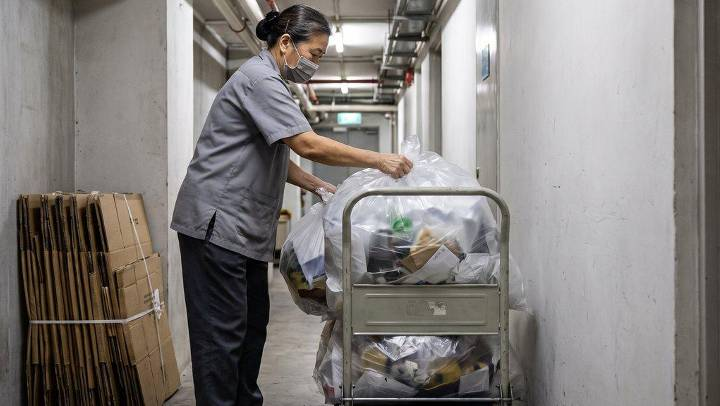
Cleaners are the only people who see every bin in the building every day. That makes them the best available source of information about what is actually being thrown away.
They can keep streams separate through collection, flag contamination patterns, consolidate cardboard, and record bag counts per stream. A simple weekly count by stream is not laboratory data, though it is usually far better than the estimate a landlord would otherwise receive. There are limits as well. Cleaners are not a sorting service, and asking a crew to pick recyclables out of general waste is neither reasonable nor safe. Contamination has to be fixed at the bin, through placement and staff communication. A crew that keeps flagging the same contaminated bin is telling you the bin is in the wrong place.
Food Waste Deserves Separate Thought
Pantry food waste is the stream most likely to cause pest and odour complaints, and the one most often left out of a segregation plan. Collection frequency does more for the problem than bin choice. A food waste bin emptied daily behaves very differently from one emptied twice a week. Larger developments here have been bringing in on-site food waste treatment, and tenants are sometimes asked to separate accordingly. Confirm what your building operates before buying bins that do not match the system.
Build the Record as You Go
The painful version of this exercise is reconstructing a year of waste data in the week before a deadline. The manageable version is a short monthly note of bag counts by stream, kept somewhere ordinary that more than one person can find.
Many of the habits behind sustainable office cleaning without compromising hygiene produce this record as a by-product. Agree with your provider who records it and where it goes, because a figure nobody owns is a figure nobody updates.
Where to Start
Read your tenancy clause. Check the current NEA guidance for your premises type. Ask your cleaning provider what they already see in your bins. Those three steps usually answer the landlord’s email without a project.
None of this needs new equipment in most offices. It needs the bins moved, the streams reduced to what staff will actually follow, and somebody keeping a simple count. Most offices can set that up inside a fortnight, and the second year is far easier than the first because the baseline already exists.
Abba handles waste collection as part of the cleaning scope for offices across Singapore, and we can set up a stream count that stands up to a landlord’s request. Speak to our team and we will work out what suits your office.

 on Google